
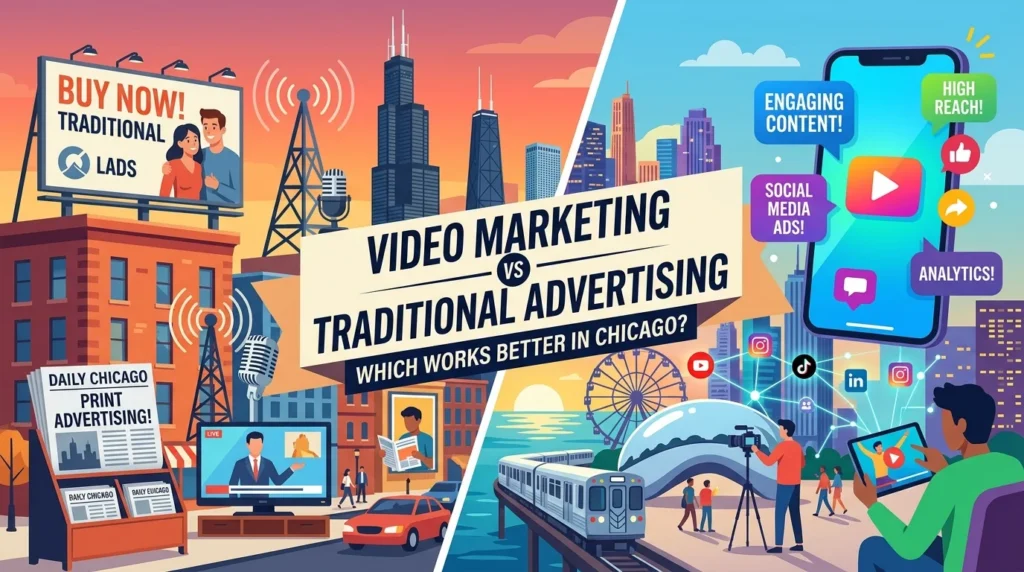
You’re a Chicago business owner, coffee in hand, staring at two quotes on your desk.
One is from a billboard company on Michigan Avenue. The other is from a video production team.
Both look promising. Both cost real money. And you have no idea which one will actually bring customers through the door.
Sound familiar? You’re not alone. Choosing the right marketing channel is one of the biggest headaches for local businesses today. This post breaks down video marketing vs traditional advertising so you can make a smarter call for your business.
Understanding Video Marketing and Traditional Advertising
Before we compare, let’s get clear on what we’re actually talking about.
What is Video Marketing?
Video marketing means promoting your business through video content. Think YouTube ads, Instagram Reels, TikTok clips, website videos, and streaming platform ads.
Chicago video marketing is booming right now. Brands are using everything from short social clips to full brand storytelling pieces. A good Full Service Video Production Company in Chicago can help you plan, shoot, and distribute content across multiple platforms.
The goal? Grab attention, tell your story, and drive action.
What is Traditional Advertising?
Traditional advertising covers all the offline stuff. Billboards, radio spots, print ads in the Chicago Tribune, direct mail flyers, TV commercials, and transit ads on the L.
It’s been around forever and still has its fans. Traditional advertising for businesses offers wide local reach, especially for audiences who aren’t glued to their phones all day.
Why Marketing Trends Are Shifting Toward Video
Something big has changed in how people consume information. And businesses that ignore it are leaving money on the table.
Consumers Prefer Visual Content
People process visuals 60,000 times faster than text, according to research from 3M. A well-made video explains your service in 60 seconds what a brochure takes three pages to do.
That’s not a small advantage. That’s a game changer.
Video Encourages Higher Engagement
Posts with video get 48% more views than those without, according to HubSpot data. Comments, shares, saves, all of it goes up when video is in the mix.
Customer engagement through video isn’t just higher. It’s often meaningful. People actually watch, react, and remember.
Chicago’s Digitally Connected Audience
Chicago has over 2.7 million residents and one of the most connected urban audiences in the Midwest. Most local consumers Google a business or watch a brand’s video before ever setting foot inside.
If your brand isn’t showing up in that digital search moment, someone else is.
Comparing Video Marketing and Traditional Advertising Side by Side
Let’s get into the real stuff. Here’s how the two stack up on what matters most.
Reach and Audience Targeting
Traditional advertising casts a wide net. A billboard on I-90 reaches thousands of commuters daily, but you can’t control who sees it.
Video advertising strategies on platforms like YouTube or Meta let you target by age, zip code, interests, income level, and even purchase behavior. Way more precise.
Cost and Budget Flexibility
A TV commercial in Chicago can cost anywhere from $5,000 to $50,000 or more. Print and radio aren’t cheap either.
Video content scales differently. A well-produced brand video from a corporate video production services team in Chicago can be repurposed across platforms for months. You shoot once, use it everywhere.
Engagement and Customer Interaction
A radio ad plays and disappears. A billboard sits there quietly.
A video? People pause it, rewatch it, tag friends, and share it in group chats. The interaction level is incomparable.
Tracking and Performance Measurement
This is where traditional advertising really struggles. It’s hard to know how many people acted on a billboard.
With video, you get real numbers. Views, watch time, click-through rates, conversions. You know exactly what’s working.
Long-Term Brand Impact
A well-crafted video lives on your website, YouTube, and social pages indefinitely. Traditional ads vanish when you stop paying for placement.
Video builds a lasting digital asset. Traditional advertising is more like renting attention.
| Factor | Video Marketing | Traditional Advertising |
|---|---|---|
| Reach | Targeted + scalable | Broad, local |
| Cost | Flexible, reusable | Often high, one-time |
| Targeting | Highly specific | Limited |
| Engagement | High, interactive | Passive |
| Measurability | Excellent | Difficult |
| Brand Building | Strong, lasting | Good for awareness |
| ROI Potential | High | Moderate |
When Traditional Advertising Still Makes Sense
Let’s be fair here. Traditional advertising isn’t dead. Not even close.
Building Local Visibility
A billboard near Wrigley Field or a transit ad on the Red Line still turns heads. For events, grand openings, or seasonal campaigns, offline ads create real buzz in specific neighborhoods.
Reaching Specific Offline Audiences
Some industries, think home services, senior care, and local insurance, still reach key customers through radio or direct mail. Local business advertising in those spaces can absolutely deliver results.
If your target customer is 60+ and listens to WGN Radio every morning, a radio ad makes a lot of sense.
Why Video Marketing Often Delivers Better Results for Chicago Businesses
For most businesses in Chicago today, video marketing is simply the stronger performer.
Better Storytelling and Brand Personality
A 90-second brand video can show your team, your culture, your work, and your values. No billboard can do that. Brand Video Production in Chicago helps businesses create content that actually connects with people on an emotional level.
Stronger Local Brand Awareness
Want Chicagoans to recognize your brand? Show them your Wicker Park office, your team at a local event, or your behind-the-scenes process. Authentic, local video builds trust fast.
Improved Conversion Opportunities
Video guides viewers toward action. A product demo video can increase conversions by up to 80%, according to Unbounce. Add a clear call to action and your video becomes a sales tool, not just content.
Common Mistakes Businesses Make When Choosing a Marketing Channel
Here’s where a lot of companies trip up.
Choosing Based Only on Cost
Going cheap often backfires. A low-budget radio ad nobody remembers is money wasted. Investment matters.
Ignoring Audience Behavior
Digital marketing trends change fast. If your audience is on Instagram and you’re mailing flyers, there’s a serious disconnect.
Failing to Measure Results
If you’re not tracking performance, you’re flying blind. Use analytics on every campaign, whether video or traditional.
Pro Tips for Combining Video Marketing and Traditional Advertising
Here’s the honest truth. The best strategy often blends both.
Use Traditional Ads to Boost Brand Visibility
A well-placed billboard creates awareness. Someone sees your brand name, goes home, and Googles you.
Use Video to Continue the Customer Journey
That’s when your video takes over. It builds trust, answers questions, and nudges them toward a decision.
Create a Multi-Channel Marketing Strategy
Think of it like a relay race. Traditional advertising passes the baton. Video carries it across the finish line. Combine online and offline touchpoints for maximum impact.
Modern video production techniques to enhance marketing strategy often include this kind of multi-channel planning from day one.
Modern Customer Journey in Chicago:
Awareness (Billboard, Radio) → Consideration (Google Search, YouTube) → Engagement (Social Video, Website) → Conversion (CTA, Contact Form) → Loyalty (Email, Retargeting Video)
Which Works Better in Chicago? Final Verdict
Okay, straight answer time.
For most Chicago businesses in 2025, video marketing wins. It offers better targeting, higher engagement, measurable results, and long-term value.
Traditional advertising still earns a spot in the mix, especially for local visibility and reaching offline audiences. But if you’re choosing where to put the bulk of your marketing budget, video is the smarter investment.
Businesses using the use of AI to speed up video production are also seeing faster turnaround and lower costs, which makes video even more accessible than before.
Conclusion
So here’s the big picture. Both video marketing and traditional advertising have their strengths. The right mix depends on your goals, your audience, and your budget.
But the trend is clear. Chicago consumers are online, they’re watching videos, and they’re making decisions based on what they see digitally.
The businesses that adapt to that shift are the ones that grow. The ones that don’t? They’re still paying for ads nobody remembers.
Whatever you choose, just make sure it’s intentional, measurable, and built around what your customers actually want.
Frequently Asked Questions (FAQs)
Is video marketing more effective than traditional advertising for Chicago businesses?
Yes, for most businesses. Video marketing offers better targeting, measurable ROI, and higher engagement than most traditional channels. It’s especially effective for Chicago brands trying to build digital presence.
What are the biggest video advertising benefits for local businesses in Chicago?
The top benefits include precise audience targeting, higher engagement rates, reusable content, better brand storytelling, and trackable performance metrics.
Can small businesses in Chicago afford video marketing?
Absolutely. Chicago video marketing ranges from affordable social media clips to full productions. Even a simple, well-shot video series can deliver strong results on a smaller budget.
Does traditional advertising still work for local businesses?
Yes, in the right context. Traditional advertising for businesses still works well for broad local awareness, older demographics, and specific industries like home services or community events.
Should businesses use both video marketing and traditional advertising together?
Ideally, yes. A combined approach gives you wide awareness from traditional ads and deeper engagement from video. That marketing channel comparison often shows the best ROI comes from using both smartly.