Remember when a 30-second product video meant three weeks of waiting, a location scout, and a budget that made your CFO wince?
Those days are fading fast.
AI innovations in video production have flipped the script for business owners who need quality video without the old-school price tag or timeline. And no, this isn’t some far-off future thing. It’s happening on shoots right now, in Chicago studios and home offices alike.
I’ve spent years around production sets watching workflows evolve. What’s happening with AI right now isn’t hype. It’s the biggest shift I’ve seen since digital cameras replaced film.
Let’s break down what’s actually changing, and what it means for your next project.
Why AI Matters to Your Video Budget Right Now
Here’s the deal: video costs are climbing, but your audience wants more content, not less.
Three pressures are squeezing business owners:
- Production costs keep rising every year
- Turnaround windows keep shrinking (nobody waits a month for a social ad anymore)
- You need five video versions when you used to need one
AI in commercial video production tackles all three head-on. It’s not magic. It’s smart automation handling the repetitive stuff, so your production team can focus on the parts that actually need a human brain.
According to Wyzowl’s 2026 survey, 63% of video marketers now use AI tools to help create or edit marketing videos, a sharp jump from the year before. That’s not a trend anymore. That’s the new normal.
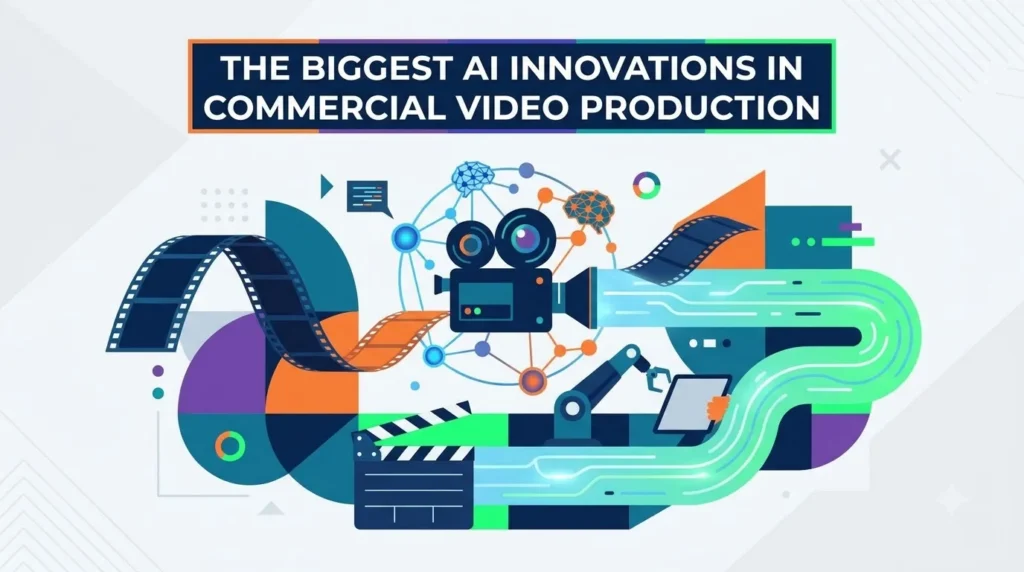
The Biggest AI Innovations Reshaping Commercial Production
Let’s get into the good stuff. Here are the innovations actually moving the needle on real commercial shoots.
AI-Powered Scriptwriting and Storyboarding
AI script tools kill the blank-page problem in minutes.
You feed the tool your brief, your brand voice, and your goals. It spits out a first draft script and a rough storyboard. Your writer then shapes it, not starts it from scratch.
Think of it like having a sharp intern who never gets writer’s block. It won’t replace your creative director, but it saves that person hours of staring at a blinking cursor.
Automated and AI-Assisted Video Editing
This is where AI video editing earns its keep.
Editors used to spend hours syncing multi-camera footage by hand. Now AI does it in minutes. It flags the best takes, cuts out dead air, and suggests pacing based on what’s held attention in similar videos before.
Need a 15-second cut, a 30-second cut, and a 60-second cut from the same footage? AI can generate all three from one master edit.
Real-world example: A Chicago-based furniture retailer I know used AI-assisted editing to turn one product shoot into 12 different social clips. Same footage. Twelve versions. One weekend of editing instead of three.
This is exactly the kind of workflow shift driving demand for commercial video production Chicago businesses are searching for right now.
AI Voice Generation and Localization
One shoot, five languages, zero reshoots.
AI voice generation creates natural-sounding voiceovers without hiring a studio booth. Localization tools take it further, dubbing your video into other languages while syncing the lip movement.
Quality has gotten genuinely good. Not perfect, but good enough for training videos, explainer content, and most ad formats.
Expert Tip: Always run AI-generated voiceover past a native speaker before publishing, especially for localized ads. Tone and slang nuances still trip these tools up more than you’d expect.
AI-Generated B-Roll, Backgrounds, and Visual Effects
Can’t afford a location shoot in three cities? AI-generated backgrounds and virtual sets solve that.
Generative AI creates supplementary footage and background replacements that used to require expensive location scouting or green screen setups. Product companies use this constantly for catalog and e-commerce videos.
Smart Color Grading and Post-Production Automation
Color grading used to mean a dedicated colorist pass, sometimes a full day of work.
AI tools now apply consistent grading across scenes automatically. They match footage shot on different cameras so everything looks like it came from the same source. That’s a huge time save on multi-camera commercial shoots.
AI-Driven Personalization for Ad Variants
Marketing teams love this one.
AI generates multiple versions of the same ad, different openings, different CTAs, different thumbnails, so you can A/B test at scale. According to research from Vidyard, AI-personalized videos generate up to 4.5 times higher click-through rates than generic versions.
That’s not a small bump. That’s the difference between a campaign that flops and one that funds next quarter’s budget.
How AI Is Changing the Commercial Video Production Workflow
The bigger picture here matters more than any single tool.
AI Video Production Trends show the entire workflow compressing, not just individual tasks. Pre-production, shooting, and editing used to run in sequence. Now a lot of it overlaps.
| Production Stage | Traditional Timeline | AI-Assisted Timeline |
|---|---|---|
| Scripting & Storyboarding | 3-5 days | 1-2 days |
| Shooting | 1-3 days | 1-3 days (unchanged) |
| Rough Cut Editing | 5-7 days | 1-2 days |
| Color Grading & Finishing | 2-3 days | 1 day |
| Multi-version Delivery | 3-4 days | Same day |
Budgets are shifting too. Instead of paying for hours of manual labor, businesses are paying for strategy and creative direction, the parts AI genuinely can’t do well yet.
Expert Tip: Getting Real Value From AI in Your Next Production
Here’s what actually works, based on what I’ve seen play out on real shoots:
- Use AI for rough cuts, not final cuts. Always have a human review before delivery.
- Ask your production partner which AI tools they use. If they can’t answer clearly, that’s a red flag.
- Budget by outcome, not by hours saved. A faster edit means nothing if the final product misses the brief.
- Test AI voice and localization on a low-stakes project first. Don’t debut it on your biggest campaign.
- Clarify content ownership upfront. AI-generated assets can raise questions about usage rights, so get this settled before the shoot starts.
Common Mistakes Businesses Make With AI Video Production
Let’s talk about where people trip up. AI Video Production Mistakes tend to follow a pattern, and most are avoidable.
Mistake #1: Assuming AI replaces the creative director.
AI handles execution. It doesn’t handle vision. Someone still needs to know what makes your brand look like your brand.
Mistake #2: Chasing tools instead of strategy.
Buying every new AI editing app doesn’t fix a weak content strategy. Tools amplify good planning. They don’t create it.
Mistake #3: Ignoring brand voice drift.
AI scripts can sound generic if you don’t feed them strong brand guidelines. Garbage brief in, generic script out.
Mistake #4: Skipping quality control on synthetic content.
AI voice and visuals need a human check every time. Small glitches slip through more often than people expect.
Myths vs Facts
| Myth | Fact |
|---|---|
| AI will replace video production companies | AI changes the workflow, but strategy and direction still need humans |
| AI video always looks fake | Modern AI-assisted editing and color grading is nearly indistinguishable from traditional footage |
| AI tools are only for big budgets | Many AI editing tools cost less than a single freelance editor day rate |
| AI voiceover works for every language equally well | Quality varies significantly by language and dialect |
Wrapping It Up
AI innovations in video production aren’t replacing the craft. They’re removing the grunt work so the craft gets more attention, not less.
If you’re a business owner weighing your next video project, the real question isn’t whether to use AI. It’s how much of your workflow you’re ready to hand over, and how much still needs a human hand on the wheel.
Talk to your production partner about their AI-assisted commercial video production process before you sign off on your next shoot. The right questions now save you money and headaches later.
FAQs
1. What are the biggest AI innovations in commercial video production right now?
The biggest ones are AI-assisted editing, automated color grading, AI voiceover and localization, and AI-generated backgrounds. Together they cut production timelines significantly.
2. Does AI video editing replace professional editors?
No. AI handles rough cuts and repetitive tasks. Editors still shape the final story and make creative calls AI can’t make on its own.
3. How is AI changing commercial video production costs and timelines?
AI can cut per-video production costs substantially and compress editing timelines from days to hours, especially for multi-version content like social ads.
4. Is AI-generated voiceover good enough for commercial use?
Yes, for many use cases like training videos and explainers. For nuanced brand ads, a human review is still recommended before publishing.
5. What AI tools do professional video production companies actually use?
Most professional studios use a mix: AI editing software for rough cuts, AI color matching tools, and voice generation platforms for localization, layered with human oversight at every stage.
6. Will AI make traditional video production companies obsolete?
Unlikely. Companies that adopt AI thoughtfully are becoming faster and more competitive, not obsolete. The ones ignoring it entirely are the ones falling behind.