
A homeowner in Phoenix hunting for a roofer. She lands on your site and scrolls past a dozen five-star text reviews. She leaves without reading one.
She isn’t lazy. Written reviews are everywhere, so they blur together. “Great service, highly recommend” sounds identical on every website.
Customer testimonial videos fix that. A real face, a real voice, and a real story give buyers proof they can feel. A short, well-directed clip often does more work than a full page of review text.
What is a Customer Testimonial Video?
A customer testimonial video is a recorded account from a real customer. They explain the problem they had, why they chose you, and what changed afterward.
It is not a case study, which leans on data and writing. It is not a scripted ad, which uses your voice. It is not a star rating, which is anonymous text.
The best ones follow a simple story arc: problem, turning point, result. That’s video storytelling at its most basic, and it works.
Common formats and where they fit
- On-site interview: Controlled lighting and clean audio. Best for your website and sales pages.
- Customer-location shoot: Natural setting, real context. Great for B2B and trades.
- Short social cutdown (15 to 30 seconds): One strong quote. Built for Instagram, LinkedIn, and paid social.
- Remote-recorded testimonial: Fast and cheap. Good when travel isn’t possible.
Expert Tip: Film at the customer’s workplace when you can. A baker standing in her own kitchen looks more believable than the same baker in front of a gray backdrop. It also gives you free b-roll.
Why Do Customer Testimonial Videos Outperform Written Reviews?
They win because video carries trust signals that text can’t. Viewers see tone, hesitation, and body language within seconds. Anyone can type a review, including the business itself.
Shoppers know this. BrightLocal’s survey found that 33% of consumers read lots of fake reviews in 2018, up from 25% the year before. That survey is a few years old, but the skepticism it describes hasn’t gone anywhere.
Faces and voices are harder to fake
A customer who pauses, laughs, and says “honestly, I almost didn’t call you” feels real. That pause is worth more than any adjective.
Fake video is possible, but it costs more effort than fake text. Buyers sense the gap, and that’s how customer testimonial videos build trust with potential customers.
Emotion travels better on camera
Compare two testimonials. One says, “Great plumber, fast service.” The other shows a dad describing a burst pipe at 11 p.m. before his daughter’s birthday party.
The second one sticks. Specific details beat generic praise every time. Ask for the story, not the compliment.
Video holds attention and gets reused everywhere
Video is now standard business practice. Wyzowl’s 2026 State of Video Marketing report shows 92% of marketers plan to spend the same or more on video this year. It also found that 69% of video marketers have created social media videos.
A text review sits in one spot. A testimonial video can live on your homepage, in emails, in proposals, and on a trade show screen.
Check your own analytics, too. Compare conversion on pages with video against pages without it. Your numbers beat borrowed ones.
One interview, many assets
A single 45-minute shoot can produce a full story, three short clips, quote graphics, and still frames. A written review gives you one block of text.
That’s the budget argument for customer testimonial video benefits. You pay for one session and get a month of content.
Video Testimonials vs Written Reviews: Which Wins?
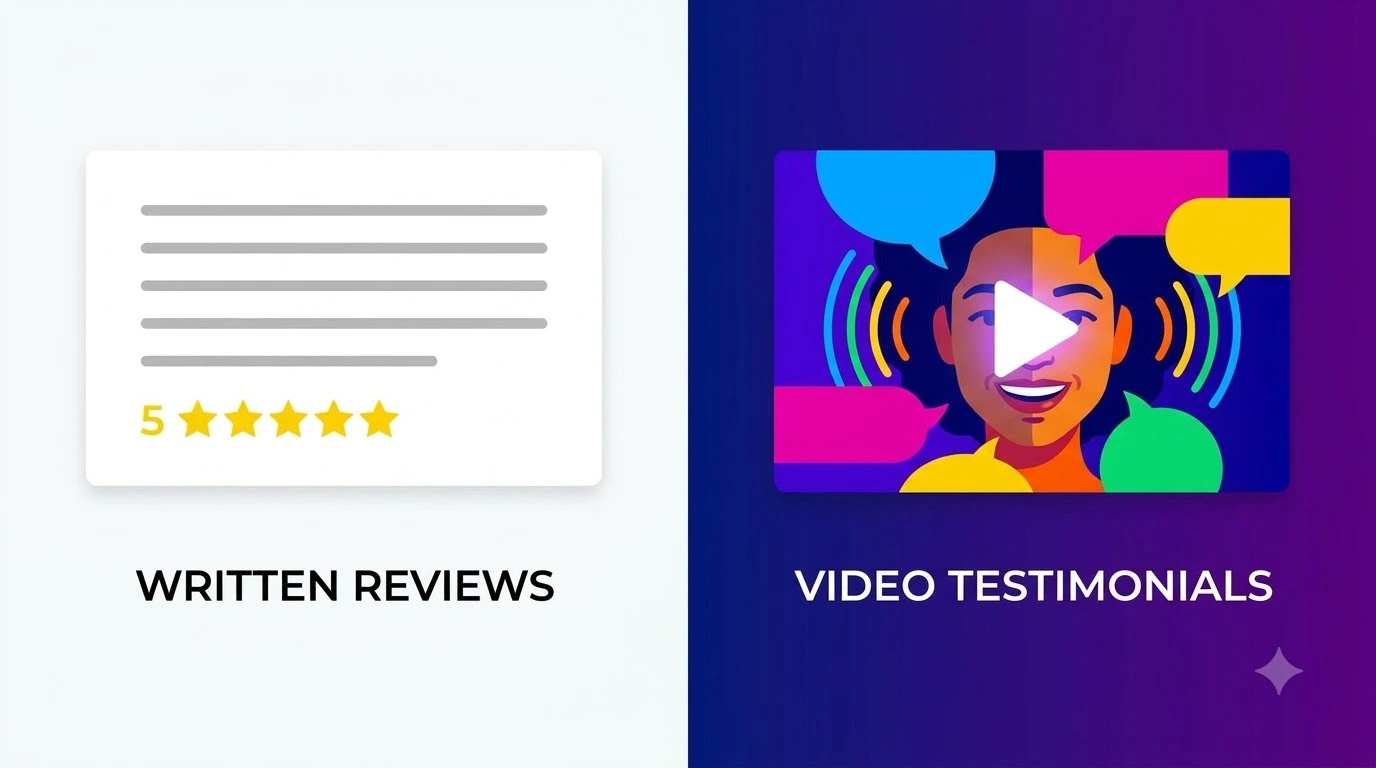
Video wins on trust and emotion. Written reviews win on speed and search presence. Smart businesses use both.
Text reviews are fast to collect and easy to skim. They also feed Google Business Profiles and review platforms. Don’t ditch them.
Table 1: Side-by-side comparison
| Factor | Written Reviews | Customer Testimonial Videos |
|---|---|---|
| Perceived authenticity | Moderate, easy to doubt | High, with face, voice, and context |
| Emotional impact | Low to moderate | High |
| Cost and effort | Low | Higher upfront, reusable |
| Speed to collect | Fast | Slower (scheduling and shooting) |
| Shareability | Limited | High across channels |
| Best use | Volume and search | Landing pages, sales, ads |
Here’s the split that works. Use written reviews for volume. Use video for high-intent moments like pricing pages, proposals, and sales follow-ups.
Table 2: Where each video length fits
| Length | Best Placement | Job It Does |
|---|---|---|
| 15 to 30 seconds | Social ads, Reels, LinkedIn | Stop the scroll |
| 60 to 120 seconds | Service and landing pages | Build trust and tell the story |
| 2 to 3 minutes | Sales emails, proposals | Answer final objections |
Wyzowl’s data backs the middle row. 71% of marketers say videos between 30 seconds and 2 minutes work best for general marketing.
Myths vs Facts About Video Testimonials
Most objections come from fear of cost or awkwardness. Here are the common ones, answered.
- Myth: You need a big budget and a full crew.
Fact: One camera, good audio, and about two hours can produce a strong result. Audio matters more than camera specs. - Myth: Customers will say no.
Fact: Happy customers often say yes when the ask is easy and specific. Offer to film at their location. - Myth: Longer is better.
Fact: Most web testimonials work at 60 to 120 seconds. Save longer cuts for sales follow-ups. - Myth: Scripts sound more polished.
Fact: Scripted lines read as ads. Guided, natural answers read as real. - Myth: Written reviews are obsolete.
Fact: They still help your search presence. Video adds to them.
What Mistakes Make Testimonial Videos Underperform?
Five mistakes cause most flops. Each has a quick fix.
- Picking the wrong customer. Choose someone with a specific, relatable result, not just your friendliest fan.
- Feeding them lines. Ask open questions like “What was going on before you called us?”
- Ignoring audio and lighting. Muddy sound kills credibility faster than a cheap camera does.
- Burying the result. Put the outcome in the first 15 seconds, then tell the story behind it.
- Skipping the next step. End with a booking link or contact page, not a logo and silence.
Expert Tip: Customers relax about ten minutes into an interview. Start the camera early and treat the first few answers as warm-ups. The best quote often shows up around minute twelve.
How Do You Produce a Testimonial Video That Converts?
Start with a 10-minute pre-interview call, film in the customer’s space, and place the finished video near the decision point. Here’s the process in order.
- Pre-interview by phone. Find the strongest story before the cameras roll.
- Write open prompts. Aim for five to seven questions. Skip the script.
- Film at their location. Capture b-roll of the customer at work.
- Pull 3 to 5 standalone quotes. Each becomes a social clip.
- Add captions. Many people watch with the sound off.
- Place it where buyers decide. Pricing page, service page, or proposal email.
- Refresh every 12 to 18 months. Old stories lose punch.
Get a signed release before filming. That’s a practical step, not legal advice, so confirm requirements with your own counsel.
Want a deeper playbook? Our guide on Strategies to Craft High-Converting Video Testimonials goes further. If you’d rather hand the whole thing off, a professional Video Production Agency can handle casting, filming, and editing.
The Bottom Line: Let Your Customers Do the Selling
Customer testimonial videos beat text on trust, emotion, reach, and reuse. Written reviews still earn their place for volume and search. The strongest plan pairs them.
Your happiest customers already have the story. Your job is to hand them a camera and a good first question.
Frequently Asked Questions
What is a customer testimonial video?
It’s a recorded account where a real customer explains their problem, why they chose you, and the result. Most run 1 to 3 minutes.
Are video testimonials better than written reviews?
For trust and emotional impact, usually yes. Written reviews still help with search and volume. Most businesses benefit from using both.
How long should a customer testimonial video be?
Aim for 60 to 120 seconds for websites and 15 to 30 seconds for social media. Longer cuts can work in sales emails.
How much does a customer testimonial video cost?
It depends on crew size, location, number of interviews, editing, and licensing. Ask vendors to break out each line item so you can compare quotes fairly.
How do I get customers to agree to be filmed?
Ask early, keep the time commitment small, and offer to film at their location. Show them the finished video before it goes live.
Where should I use customer testimonial videos?
Use them on landing and service pages, in email, paid social, proposals, sales decks, and event screens.